
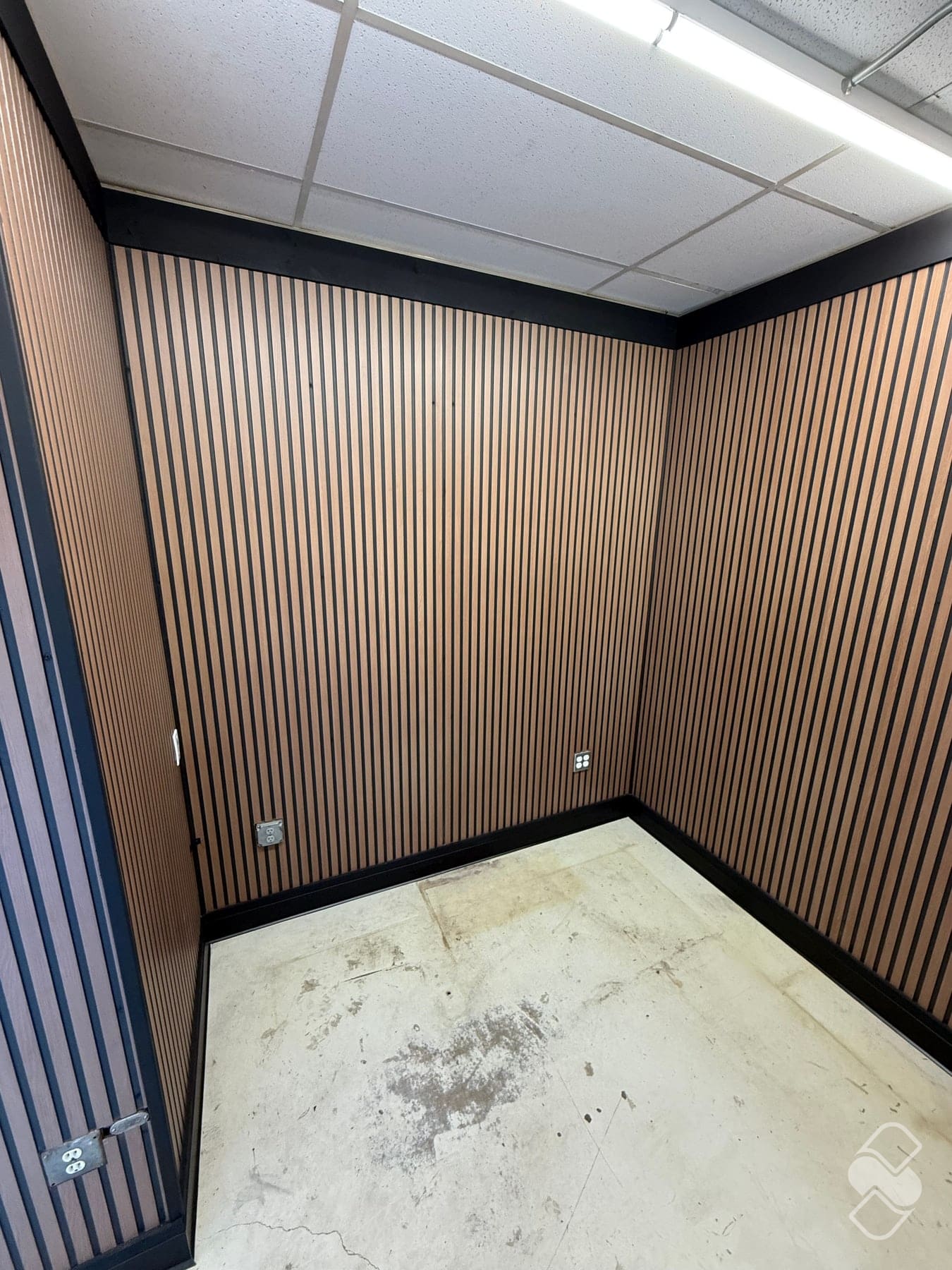
Not every commercial job is a build-out from a shell. A lot of the businesses we work with have a corner that is not working for them: a storage nook that should be an office, a block room nobody wants to sit in. We did exactly that for Circle D Transmission, off Hempstead in Houston, and it is a good picture of how a small commercial job runs. Photos and the day-by-day are on the project page.
The starting point
Painted concrete block, a drop ceiling, a steel door, conduit running on the surface of the walls and a bare concrete floor. It was a corner of a working transmission shop, with parts shelving in the next room and the business open the whole time.
Step one: protect what is already there
In a shop, dust lands on inventory. Before we cut anything we hung plastic over the pegboard wall and the shelving right behind it. That takes an hour and saves a week of complaints. It is also the first thing to ask about when you get a quote: how will you keep the dust off my stock?
Block walls need a frame
A finished wall does not hang well directly on block, and block has no insulation of its own. We fastened horizontal furring strips to the block from floor to ceiling, set a vertical strip beside the steel door frame, and fitted rigid foam insulation board into every bay between the strips. The existing conduit and outlet boxes stayed where they were, which is the cheapest way to handle electrical in a room like this.
Finish that suits a shop
For the walls we used wood look slat wall panels from a Houston supplier over the furring on all three block walls, cut around the outlets, a conduit fitting and a data plate so everything sits flush. A black band at the ceiling line and black base trim finish the edges and wrap the corners. Drywall would have worked too, but slat wall goes up fast, hides an uneven block wall, and takes a knock from a rolling chair without needing paint. The floor and the drop ceiling stayed as they were.
How long it takes
All three walls were paneled by the end of the first day and we photographed the finished room the next morning. A day and a half, in a business that never closed. Small commercial jobs are mostly about sequence and protection, not size.
What to ask before a small commercial job
- How will you protect our inventory and keep the shop running?
- What goes on the block first, and is insulation included?
- Are you moving any electrical, or working around what is there?
- Can you work early, late or on a weekend if that keeps us open?
If your shop, office or storefront has a corner that should be earning its keep, see how we handle commercial work or ask us to come look.