
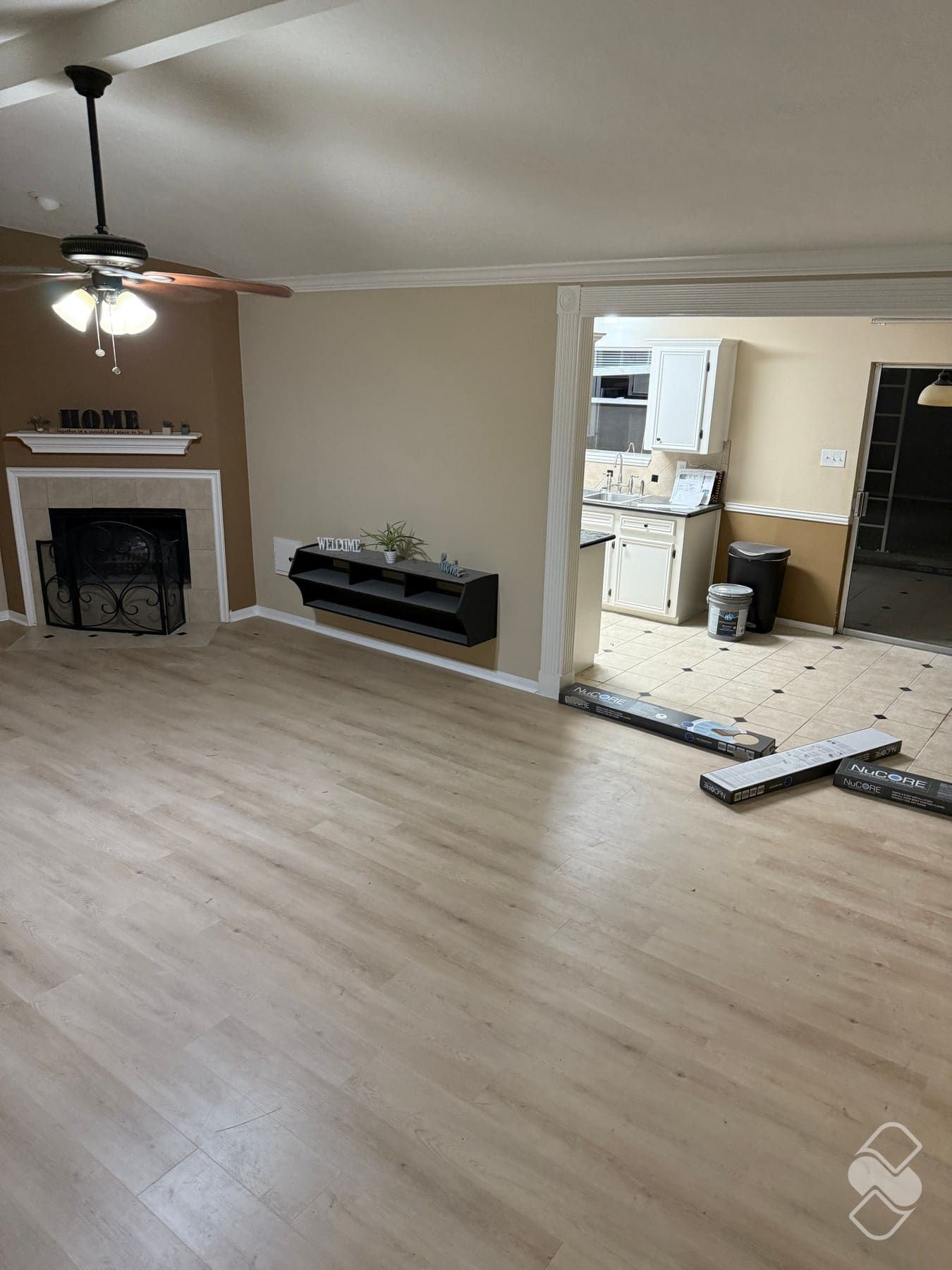
Most Houston homes sit on a concrete slab, and a lot of them have the water heater in the attic. When that tank lets go, the water does not stay in one room. It runs down inside the walls, follows the slab, and spreads under whatever floor is on top of it. We rebuilt a living room floor after exactly that in late 2024, and the job is a good map of what actually happens and what has to be done about it. You can see the whole project in our flooded living room story.
Where the water goes on a slab home
Tile looks waterproof. The grout and the thinset under it are not. Water that reaches a tiled floor works into the grout lines, sits in the thinset bed, and wicks along the slab under the tile. It also soaks the bottom of the drywall and the baseboards, and it finds any low spot in the slab and stays there. On the surface the floor dries in a day. Underneath, it can stay wet for weeks.
That is why a floor that "looks fine" after a flood is the one to worry about. Trapped moisture under tile loosens the bond, so tiles start to sound hollow and crack. Moisture under a floating floor or carpet turns into a smell first and a mold problem second.
Step one is drying, not demo
Before anyone talks about new flooring, the house has to be dried. That means getting standing water out, pulling wet baseboards, opening the bottom of wet walls, and running air movers and dehumidifiers until moisture readings in the slab and the studs come down. If insurance is involved, photograph everything before it moves and let the adjuster see the damage. Tearing a floor out early can complicate a claim.
Why the old floor usually comes up
In our living room job every square foot of the old beige ceramic tile came up. Three reasons that hold for most flood jobs:
- The bond is compromised. Once water has been under tile, it is hard to trust the thinset. Sections that seem fine today pop loose next year.
- You cannot dry what you cannot reach. Pulling the floor lets the slab dry properly and lets you see what the water did.
- The slab underneath is rarely flat. Old tile hides a lot. When it comes up, you see the real surface, and it is usually rough, with high and low spots the tile was bridging.
The part most people skip: leveling
The new floor is only as good as what it sits on. Rigid and click-together plank has a flatness tolerance, and a slab that is out of that tolerance gives you planks that flex, joints that open, and a floor that clicks and pops underfoot. In the living room we floated the entire area with self-leveling underlayment rather than chasing individual low spots. Poured leveler finds its own level, which is why the wet floor in those photos reads like a mirror with the front window in it. It cured overnight and gave us one flat plane from the entry to the kitchen. We wrote more about why prep decides the outcome in this guide to subfloor prep for LVP.
Then the floor
With a cured, clean, flat slab, the flooring itself is the fast part. A poly layer went down, the light oak plank was cut and tapped in row by row, and the new floor met the existing kitchen tile with a T-molding at the doorway. In the finished photos the boxes of flooring are still sitting on that transition. They are holding the T-mold flat while the adhesive set. The whole room went in over a couple of days once the prep was done. Baseboards and paint follow the floor, never the other way round.
The order of work, in one list
- Stop the water and get it out.
- Document for insurance, then dry the structure with equipment, not time.
- Pull wet baseboards and the bottom of wet drywall.
- Remove the old floor down to the slab.
- Check moisture in the slab before anything goes back.
- Level. Float the whole area if the slab is rough.
- Install the new floor and transitions.
- Baseboards, drywall repair, paint.
What to ask whoever quotes it
- Are you taking the whole floor up, or patching around the wet area? Patching a flooded tile floor is how you end up doing it twice.
- How are you checking that the slab is dry before the new floor goes down?
- Is leveling in the quote, and is it spot patching or a full float?
- What transition goes in where the new floor meets the tile you are keeping?
Done right is cheaper than done twice. If you are looking at a floor after a leak or a flood in Katy or Greater Houston, we will tell you plainly what has to come up and what can stay. Start with our water damage repairs page or ask for a quote.