
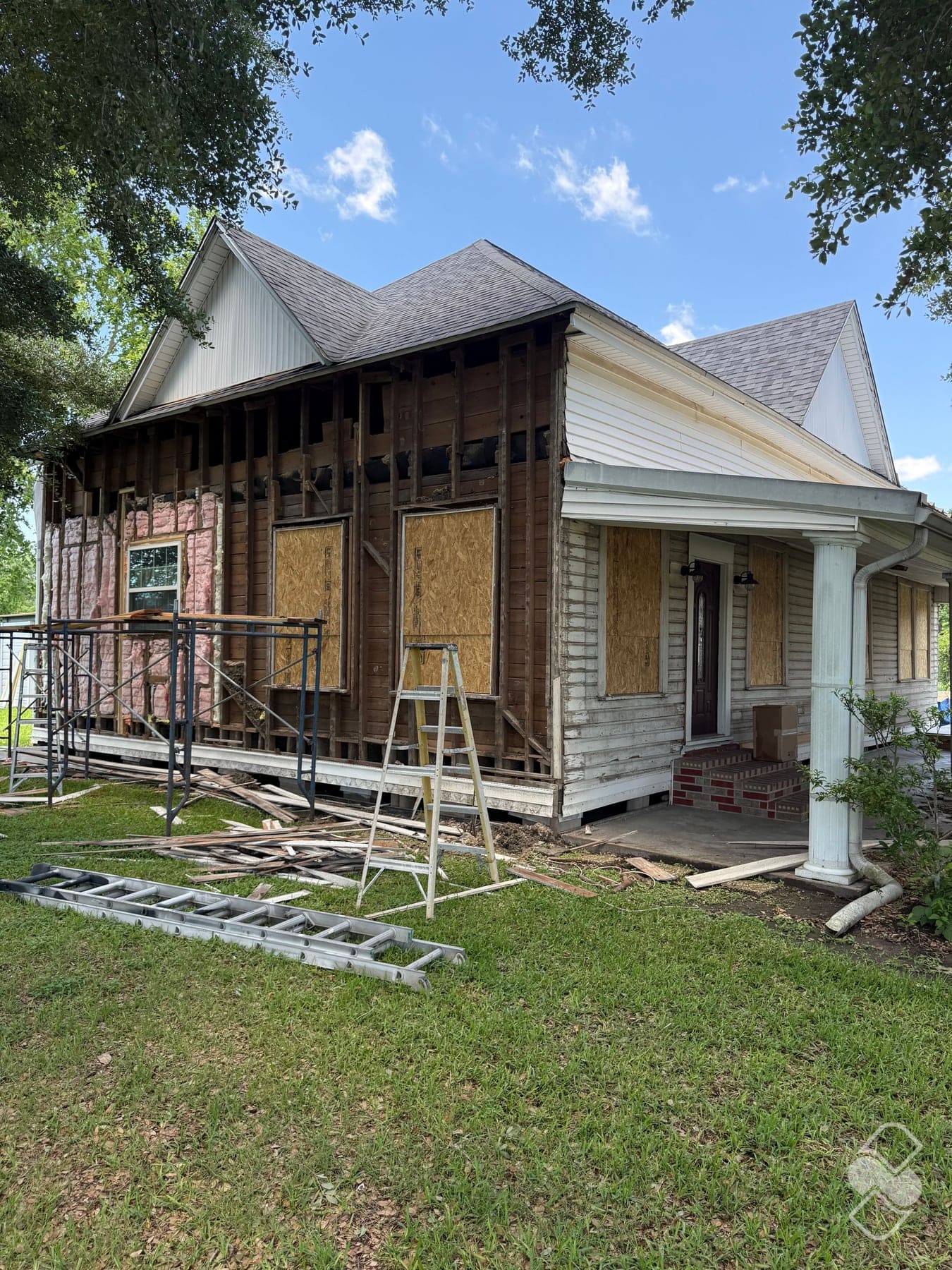
Most siding calls start small: a few rotted boards, paint that will not hold, a corner that has pulled away. Sometimes the honest answer is a repair. Sometimes the boards are the symptom and the whole skin of the house needs to come off. We did the second kind on a 1920s farmhouse in Sugar Land this year, and it is a good walk-through of what "re-side it" really means. The full story is on Gina's farmhouse page.
When repair stops making sense
Three signs, and this house had all three. The old lap siding was peeling on every elevation, not one. The bottoms of the walls were soft where water had been getting behind the boards for years. And there was nothing behind the siding but studs: no sheathing, no house wrap, no insulation, which is normal for a house of that age and a problem for a house in Houston. Patching new boards onto that is money spent twice.
What comes off
Everything, one elevation at a time. The old siding comes down to the framing so we can see what the water did. On this house that meant rotted sill and stud bottoms in several places, which we shored with treated blocking before anything went back on. The porch turned out to have its own problem: the beam line had been carried across more than sixty feet on four posts, and it had sagged badly. The shed out back was rotted at the base plates and studs. None of that is visible until the siding is off, which is why a re-side quote should carry an allowance for framing repair and a clear price per foot if more is found.
What goes on before the siding
This is the part that separates a re-side from a re-skin. With the walls open we added OSB sheathing over the studs, wrapped the house, and insulated every bay. The porch got new posts, a beam sistered alongside the old one, a plywood ceiling and recessed lights, and when we were done the porch line ran straight across the whole stretch. The shed was reframed where it needed it and sheathed the same way. Only then does the siding go on.
Hardie, and what that includes
We used James Hardie lap siding and Hardie trim, with matching soffit, fascia and gable vents, then gutters, downspouts and lattice skirting. Fiber cement is the right call in our climate: it does not rot, termites do not eat it, and it holds paint far longer than wood. It is heavy and it is unforgiving of a wavy wall, so the sheathing step matters twice.
Who does what
A re-side touches other trades, and it is worth knowing who owns which piece before you sign anything.
- Electric meter. The siding has to go on behind the meter base. We handled the small electrical for the new exterior lighting, and CenterPoint disconnected and reconnected the meter.
- Windows. Gina had her own window company lined up to come in after us, so we trimmed the openings and left them ready. If you are replacing windows, decide that before the siding goes on, not after.
- Paint. Hardie comes primed. Gina's painter came in behind us. Paint can be part of a re-side scope or a separate one; just make sure somebody owns it.
What to ask whoever quotes it
- Are you removing the old siding or going over it? Going over it hides rot.
- Is sheathing and house wrap in the price? If the house has none, it should be.
- How is framing rot priced if you find it?
- Who handles the meter, the windows and the paint, and in what order?
- What does the porch or any add-on structure need? Ask for it to be looked at, not assumed.
Done right is cheaper than done twice, and nowhere is that more true than the outside of a house. If yours is peeling or soft at the bottom, start with our Hardie siding repair page or ask us to come look.