
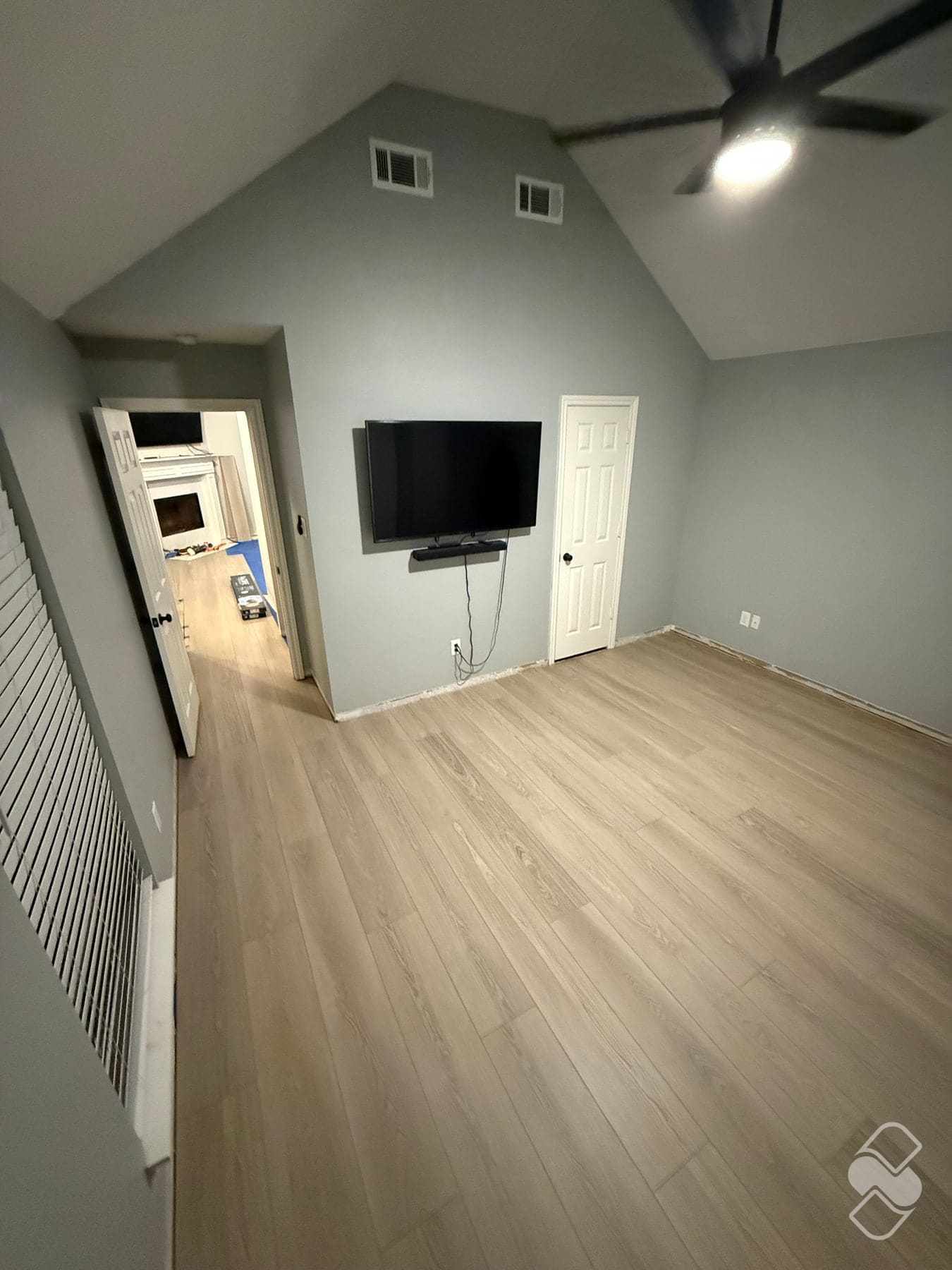
Swapping carpet for plank is one of the most common jobs we do for people who have just bought a house. It looks simple from the doorway: pull the carpet, click in a floor. The jobs that turn out well are the ones where somebody planned the parts you cannot see from the doorway. We did exactly this for a new homeowner named Britney, across three bedrooms, the living room and every common space in her house, and it makes a good walk-through. The photos are on her project page.
What actually comes out
Carpet is three layers, not one: the carpet, the pad under it, and the tack strips nailed around every wall. All three have to come up, and the tack strip nails leave small craters in the slab that need to be scraped flat. It is also bulky. A whole house of carpet and pad fills a garage, so ask where it goes. We stage it in the garage and haul it, rather than leaving rolls piled in the rooms you are trying to live in.
What you find underneath
Every carpet job has a surprise, and it is better to expect one. At Britney's house there was old peel and stick plank under some of the carpet and running through the hallway and doorways. That had to come up too, along with its adhesive, or the new floor would have had a ridge everywhere the old layer stopped. Other common finds are paint overspray and drywall mud from the original build, cracks in the slab, and low spots. None of these are emergencies. All of them have to be dealt with before a floating floor goes down, because plank is only as flat as what it sits on. We go deeper on that in our guide to subfloor prep.
One floor or several
This is the decision that changes how the finished house feels. You can floor each room separately and put a transition strip in every doorway, or you can run one continuous floor through the bedrooms, the hall and the living areas with no strips at all. One floor looks far better and makes the house feel bigger. It also asks more of the installer:
- The layout has to be set once for the whole house, not room by room. We snap a laser line so the rows stay parallel from the first bedroom to the last.
- The planks run in a single direction through every doorway, which means the door jambs get undercut so the plank slides beneath them cleanly.
- Most plank products have a maximum run before they need an expansion break. A good installer knows that number for your product and plans where a break can hide.
The product
For Britney's house we installed NuCore waterproof rigid plank in a light oak color over underlayment. Rigid core plank is the right call for most slab homes here: it shrugs off humidity and spills, it is quiet underfoot, and it clicks together without glue. If you are still choosing between plank, tile and hardwood, this comparison covers the trade-offs for our climate.
Where it meets tile
Most homes keep their tile in the kitchen, baths and entry. Where new plank meets existing tile you need a transition that handles the height difference and gives the floating floor room to move. It is a small detail that sits in the most visible spots in the house, so ask to see what the installer plans to use before the day it goes in.
Baseboards are part of the job
Carpet hides the bottom inch of your baseboards, and it sits higher than plank does. Once the carpet is gone you are left with a paint line and a gap. The clean fix is what we did for Britney: all new baseboards throughout, installed after the floor went down. Quarter round over the old baseboards is cheaper and looks like it. Decide which you want before you compare quotes, because it is often the difference between two prices.
How long each floor lasts
If you are pulling carpet anyway, it is worth knowing what you are trading it for. These are typical lifespans in a lived-in home, and care and traffic move them in both directions.
- Carpet: about 5 to 15 years. A good carpet over a good pad in a bedroom can see the long end. In a hallway with kids and pets it will look tired well before that. It is the softest and warmest floor, and the one you will replace most often.
- Luxury vinyl plank: about 15 to 25 years. Thin budget plank can be closer to 10. The wear layer is what you are buying, so it is the number to compare between products. Plank cannot be refinished, but a damaged board can be replaced.
- Porcelain or ceramic tile: 50 years or more. Tile usually outlasts the taste of the person who picked it. Grout needs cleaning and occasional sealing, and a cracked tile can be swapped if you kept a spare box.
The honest summary: carpet is a comfort choice you renew, plank is the practical middle, and tile is close to permanent. None of them is wrong. They fit different rooms and different plans for the house.
How each one goes in
The install is where the three floors differ most, and it explains most of the price difference.
- Carpet. Tack strips around the room, pad rolled out and seamed, carpet stretched tight onto the strips and trimmed at the walls. It forgives an imperfect slab, which is part of why it is the fastest and least expensive floor to install. A bedroom is a few hours.
- Plank. The slab is scraped, checked for flatness and corrected where it is out. Then underlayment, a layout line, and the planks click together as one floating floor with a small gap at every wall for movement. Baseboards or trim cover the gap. A whole house is usually a matter of days.
- Tile. The most labor of the three. The slab has to be flat and sound, cracks get treated so they do not telegraph through, the layout is planned so cuts land where they look right, and every tile is set in mortar and leveled against its neighbors. Then it cures, gets grouted, and cures again before furniture goes back. Long wood-look planks are the least forgiving tile to set, because any lip between two long edges shows. We set that kind of tile in Dede's bedrooms.
How the three compare on price
Every house prices differently, so rather than quote numbers that may not fit yours, here is how the three floors relate to each other. Take carpet as the baseline.
- Carpet is the least expensive floor to buy and the fastest to install.
- Luxury vinyl plank typically runs about 20 to 35 percent more than carpet, installed. The material costs a little more and the slab has to be prepped more carefully.
- Porcelain or ceramic tile typically runs close to double the price of plank, and a little more than double carpet. Most of that difference is labor. Long wood-look planks, large formats and patterns sit at the top of that range.
- Tear-out depends on what is coming up. Pulling carpet is the cheapest tear-out there is. Chipping up old tile can cost two to three times as much for the same area.
- Leveling and slab prep, when a floor needs it, can add a quarter to a half again to the price of a plank floor. It is the line most worth paying for, and the one most often missing from a low bid.
Now put price next to lifespan. Carpet costs the least on day one and gets replaced the most often. Tile costs the most on day one and may never be replaced. Spread over the years each one lasts, tile is often the least expensive floor you can own, plank sits in the middle, and carpet is the most expensive, which is the reverse of how the quotes read. How long you plan to stay in the house should drive the choice as much as the install price does.
What moves a price for any of them is mostly what is under the old floor, the product you choose, how many doorways, closets and cuts there are, stairs, and whether the house is empty or lived in. That is why two honest quotes for the same house can differ, and why the right comparison is line by line, not total to total. Our guide on comparing remodeling bids walks through how to do that. For real numbers on your house, we measure, look at the slab, and write it down.
How long, and can you live there
A whole-house carpet to plank job is days, not weeks. The rooms have to be empty, so the easiest time by far is before you move in, which is why we see so many of these right after a closing. If you are already living there, it can be done in phases, a few rooms at a time, with furniture shuffled between them.
What to ask whoever quotes it
- Does your price include tear-out, haul-off and scraping the slab?
- What happens if there is another floor or old adhesive under the carpet?
- Are you checking the slab for flatness, and is leveling in the quote or extra?
- One continuous floor or transitions at the doors? How are you handling the door jambs?
- New baseboards, or quarter round over the old ones?
- What goes in where the plank meets my tile?
Done right is cheaper than done twice. If you just bought a house in Katy or Greater Houston and the carpet is the first thing you want gone, start with our luxury vinyl plank page or ask us for a quote.